Sweet Almond, a name in traditional Chinese medicine. It refers to the dried, sweet seeds of certain cultivated varieties of Prunus armeniaca L. or Prunus armeniaca L. var. ansu Maxim., plants belonging to the genus Prunus in the Rosaceae family. It has the effects of moistening the lungs and relieving wheezing. It is primarily used to treat coughing and wheezing due to deficiency-syndrome, as well as constipation caused by intestinal dryness.
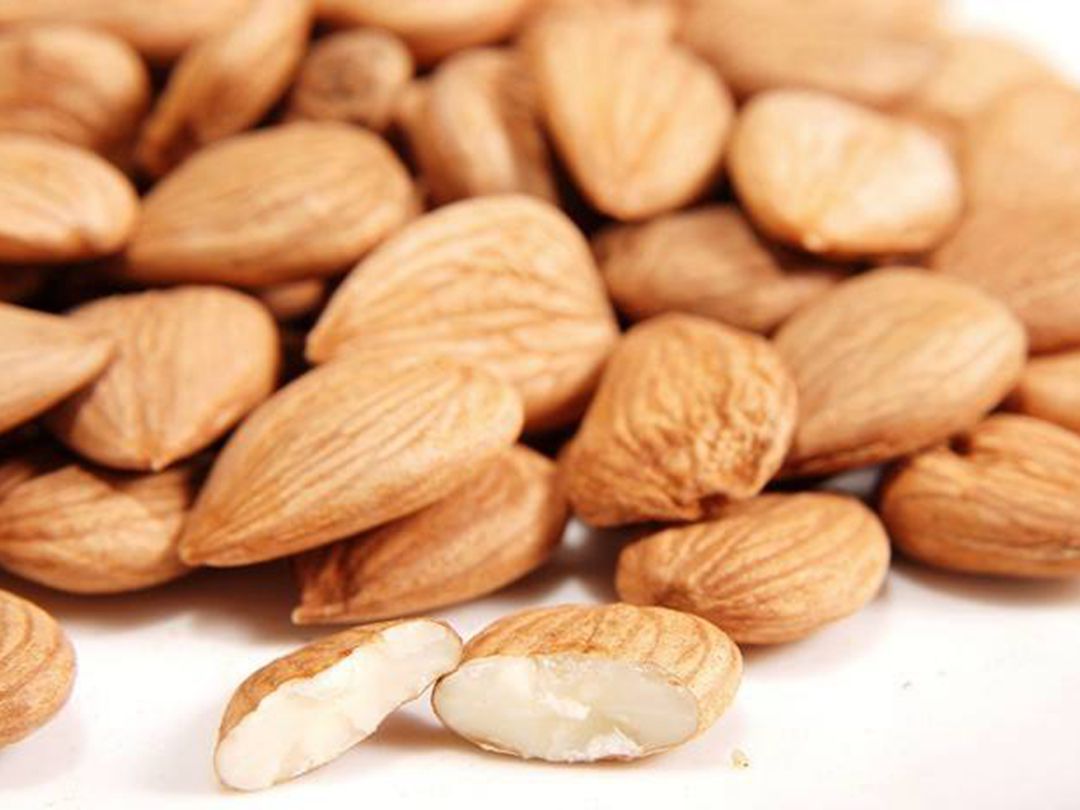
Sweet Almond
Sweet Almond, a name in traditional Chinese medicine. It refers to the dried, sweet seeds of certain cultivated varieties of Prunus armeniaca L. or Prunus armeniaca L. var. ansu Maxim., plants belonging to the genus Prunus in the Rosaceae family. It has the effects of moistening the lungs and relieving wheezing. It is primarily used to treat coughing and wheezing due to deficiency-syndrome, as well as constipation caused by intestinal dryness.
Chinese Name : 甜杏仁
Latin Name : Armeniaca vulgaris Lam., A. vulgaris Lam. var. ansu (Maxim.) Yu et Lu
Aliases : Southern Apricot Kernel, Apricot Kernel, Apricot, Muluozi, Apricot Plum Kernel, Sweet Apricot Kernel, White Apricot Kernel, Smooth Apricot Kernel
Nature, Flavor & Meridian Tropism : Sweet in taste, neutral in nature. Non-toxic; enters the Lung and Large Intestine meridians
Benefits & Efficacy
Benefits
Moistens the lungs and relieves wheezing.
Indications
Mainly used for cough and wheezing due to deficiency-syndrome, and constipation caused by intestinal dryness.
Usage and Dosage
Internal use: Decocted as a soup, 6–12 g; or eaten raw; or sun-dried into jerky, in appropriate amounts.
Precautions
Should not be consumed in large quantities.
Chemical Constituents
Vitamins A, B1, B2, B6, and E; protein; fatty acids.
Relevant Discussions
1. *Modern Practical Chinese Herbal Medicine*: Possesses moisturizing properties; when taken internally, it has a mild laxative effect and provides tonic benefits. Externally, it is often used as a dressing for skin peeling to provide protection.
2. *Chronicle of Sichuan Chinese Herbal Medicine*: Moistens the lungs, soothes the stomach, expels phlegm, and relieves cough. Treats cough and wheezing due to deficiency-syndrome, as well as epigastric fullness and distension; it is particularly suitable for treating dry and deficiency-type coughs.
Applications
Clinical Applications
Treatment for mouth sores: Take one apricot, one segment of Coptis, and one cun of licorice—these three ingredients combined—wrap them in cotton, and place the bundle in the mouth to be held there. (*Formulas from the Heart of Medicine*)
Related Medicines
Apricot and Perilla Cough-Relief Granules (syrup), Tangerine Peel and Red Tangerine Cough-and-Phlegm Granules (decoction paste, liquid), Apricot Kernel Cough-Relief Syrup, Bitter-Sweet Granules, Apricot, Perilla, and Erchen Pills.
Related Prescriptions
Sanren Decoction (*Treatise on the Differentiation of Warm Diseases*), Ephedra, Apricot Kernel, Licorice, and Gypsum Decoction, Ephedra, Apricot Kernel, Coix Seed, and Licorice Decoction, Mulberry and Chrysanthemum Decoction, Mulberry and Apricot Decoction, Donkey-hide Gelatin and Scutellaria Decoction (*Revised Popular Treatise on Cold Damage*), Dongtian Su Xiang Ointment (*Selected Precious and Secret Formulas Worth a Thousand Gold*), and Harmonizing and Promoting Digestion Decoction from *Medical Case Records of Cheng Menxue*,names listed in *Famous Formulas of Ancient and Modern Times*; Qi-Descending and Meridian-Harmonizing Decoction from *Revised Popular Treatise on Cold Damage*; Lung-Clearing and Heat-Purging Decoction from *Treatise on the Six Stagnations* (Middle Volume); Meridian-Clearing Decoction with Added Licorice, Tangerine Peel, Sweet Apricot Kernels, and Ophiopogon Decoction from *Treatise on Warm Diseases* (Volume 1); Three-Seed Porridge from *Medical Levels* (Volume 8); Four-Seed Porridge from *Folk Formulas*; and Five-Seed Porridge from *Formulas Based on Clinical Experience*.
Processing & Preparation
Harvesting & Processing
Harvest when the fruit ripens in summer; remove the pulp and seed coat, extract the seeds, and dry them.
Processing Methods
1. Sweet Almond Kernels: Take the raw material, remove impurities, and sift out碎屑. Crush before use.
2. Blanched Sweet Almonds: Take clean sweet almonds and remove the skins using the blanching method (Appendix I). Crush before use.
Storage Methods
Store in a cool, dry place to prevent insect infestation and rancidity.
Crude Drug Identification
Properties of Processed Slices
1. Sweet Almond: Flat and heart-shaped, 1.6–2.6 cm long and 12–1.6 cm wide. The apex is pointed, the base is rounded, and the shape is asymmetrical. The seed coat is thicker than that of bitter almonds and is pale yellowish-brown. The kernel is milky white and rich in oil. It has a faint odor and a slightly sweet taste.
2. Blanched Sweet Almonds: Similar in shape to sweet almonds; some may split into single segments with a milky-white surface. They have a distinctive aroma and a slightly sweet taste.
Botanical Information
Botanical Classification
Prunus species of the Rosaceae family, specifically the common apricot or wild apricot.
Morphological Characteristics
1. Apricot: A deciduous small tree, 4–10 m tall; bark dark reddish-brown, longitudinally fissured. Simple, alternate leaves; leaf blades rounded-ovate or broadly ovate, 5–9 cm long, 4–8 cm wide. Flowers bloom before the leaves emerge in spring; flowers are solitary at branch tips, arranged relatively densely, somewhat resembling a raceme;Flowers are nearly sessile; the calyx is tubular at the base, covered with short soft hairs on the outside, and 5-lobed at the top; there are 5 petals, white or pale pink, round to broadly obovate; numerous stamens are attached to the margin of the calyx tube; the pistil is monocarpellary and attached to the base of the calyx tube. The drupe is round, rarely obovate, with a diameter of 2.5 cm or more.Seed: 1, heart-shaped-ovate, pale red. Flowering period: March–April; fruiting period: June–July. 2.
2. Mountain Apricot: A shrub or small tree, 2–5 m tall. Leaves ovate or nearly round, (3–)5–10 cm long, (2.5–)4–7 cm wide. Flowers solitary, 1.5–2 cm in diameter;sepals oblong-elliptic, with acute tips; petals nearly round or obovate, white or pink. Fruit is flattened-globose, 1.5–2.5 cm in diameter, flattened on both sides; the flesh is thin and dry, splitting open when ripe, with a sour and astringent taste. The stone separates easily from the flesh; the base is asymmetrical on one side and smooth. Flowering period: March–April; fruiting period: June–July.
Distribution Area
1. Apricot: Distributed throughout China, mostly cultivated. Wild populations are found in the Ili region of Xinjiang. 2. Wild Apricot: Distributed in Northeast China, North China, and Gansu, among other areas.
Growth Habits
Highly adaptable, drought-tolerant, cold-hardy, tolerant of poor soils, and resistant to saline-alkali conditions. It can grow normally at summer temperatures as high as 43.9°C and overwinter safely at temperatures as low as -40°C. It can be planted on flat land or slopes and is not particular about soil type.
Propagation Methods
Propagation is by seed or grafting.
Cultivation Techniques
1. Seed Propagation: Harvest ripe fruits, rub off the pulp, and collect the seeds. Mix the seeds with moist sand at a ratio of 1:3 for winter sand stratification.Sow in late March for spring planting, or in late November for fall planting (seeds for fall planting do not require sand stratification; simply air-dry them in a well-ventilated, shaded area before sowing). Sowing is typically done in wide ridges, with one row per ridge. For spot sowing, space plants 10–15 cm apart, placing one seed per hole. After sowing, cover with 5–6 cm of soil (approximately three times the diameter of the seed) and firm the soil.
2. Grafting Propagation: Use seedling rootstocks from apricot or wild apricot seedlings. Branch grafting is performed in late March, while bud grafting is carried out from early July to late August.
Pest and Disease Control
1. Diseases include apricot leaf spot. Spray with a 5-degree lime-sulfur solution before budbreak and a 0.3-degree lime-sulfur solution when leaves unfurl.
2. Pests include the apricot weevil, as well as bagworms, longhorn beetles, and others.