Tamarind is a name used in traditional Chinese medicine. It refers to the fruit of Tamarindus indica L., a plant in the genus Tamarindus of the Fabaceae family, which is used medicinally. It is distributed in Fujian, Taiwan, Guangxi, Guangdong, Sichuan, Yunnan, and other provinces and regions. It has the effects of clearing heat, relieving summer heat, aiding digestion, and resolving food stagnation. It is primarily used to treat heatstroke, loss of appetite, childhood malnutrition, morning sickness, and constipation.
Tamarind
Tamarind is a name used in traditional Chinese medicine. It refers to the fruit of Tamarindus indica L., a plant in the genus Tamarindus of the Fabaceae family, which is used medicinally. It is distributed in Fujian, Taiwan, Guangxi, Guangdong, Sichuan, Yunnan, and other provinces and regions. It has the effects of clearing heat, relieving summer heat, aiding digestion, and resolving food stagnation. It is primarily used to treat heatstroke, loss of appetite, childhood malnutrition, morning sickness, and constipation.
Chinese Name : 罗望子
Aliases : Dujuezi, Suanjiao, Suandou, Luohuangzi, Tongxietu
Nature, Flavor & Meridian Tropism : Taste: sweet and sour; nature: cool; enters the Stomach and Liver meridians
Benefits & Efficacy
Benefits
Clears heat and relieves summer heat; aids digestion and resolves food stagnation.
Indications
Mainly used to treat heatstroke, loss of appetite, childhood malnutrition, morning sickness, and constipation.
Usage and Dosage
Decoct in water and take 15–30 g.
Precautions
Excessive or prolonged use may cause coughing; jujubes and granulated sugar can be used to counteract this effect.
Chemical Constituents
The fruit contains α-tartaric acid, citric acid, L-malic acid, formic acid, serine, β-alanine, proline, phenylalanine, and 2-piperidinecarboxylic acid. It also contains starchy proteins, various phospholipid compounds, and tamarind polysaccharides (composed of glucose, galactose, xylose, etc.).The seeds contain fatty oils and polysaccharides, as well as tannins.
Pharmacological Actions
It aids digestion, relieves bloating, and alleviates sore throats. The raw fruit pulp has a mild laxative effect. The seed coat is used to treat dysentery, and a decoction of the seeds is used to treat abscesses. A decoction of the leaves has antibacterial properties.
Relevant Discussions
1. *Annotated Medical Canon*: “It cleanses the large intestine, reduces fever, alleviates vomiting, clears heat, and quenches thirst. It is primarily used to treat constipation, fever, nausea, vomiting, and thirst caused by stomach heat.”
2. *The White Palace*: “It clears excess bile, clears heat, tonifies the stomach, and quenches thirst and stops vomiting.It is primarily used to treat dry, hard stools, stomach heat with thirst, and nausea and vomiting caused by an excess of bile.”
3. *Baidi Yi Herbal*: “It clears excess bile from the entire body, cleanses the large intestine, clears heat and increases appetite, clears heat and tonifies the stomach, stops vomiting and quenches thirst, relieves summer heat and detoxifies, calms the mind and alleviates anxiety, reduces jaundice, dispels wind and relieves itching, and reduces inflammation and heals wounds.It is primarily used to treat systemic excess of bile, intestinal obstruction, dry and hard stools, poor appetite due to stomach heat, burning sensation in the epigastrium, nausea and vomiting, dry mouth and intense thirst, heatstroke-induced fainting, palpitations and anxiety, jaundice of the face and eyes, itchy skin, and oral ulcers.”
4. *The Garden of Medicinal Herbs*: “It has the effects of clearing heat and strengthening the heart, tonifying the stomach, alleviating bile-related nausea and vomiting, clearing heat and lowering blood pressure, calming the mind and relieving anxiety, dispelling wind and relieving itching, and treating cholera, diphtheria, and oral ulcers.It is primarily used to treat heat-induced heart deficiency and stomach deficiency; bile-type nausea and vomiting; high blood pressure; palpitations and anxiety; itchy skin; cholera; diphtheria; and mouth ulcers.”
Applications
Clinical Applications
1. To treat systemic excess of bile, intestinal obstruction, dry and hard stools, poor appetite due to stomach heat, epigastric heat, nausea, vomiting, dry mouth, thirst, fainting, palpitations, and jaundice: Take an appropriate amount of tamarind seeds, steep them in boiling water until the medicinal properties are released, and drink the solution. (*Bai Di Yao Shu*)
2. To treat itchy skin: Take an appropriate amount of tamarind seeds and drink the resulting decoction. (*Bai Di Herbal*)
3. To treat mouth ulcers: Take an appropriate amount of tamarind seeds, soak them in boiling water, and once cooled, use the solution to rinse the mouth. (*Bai Di Herbal*)
4. For heat-induced heart deficiency, stomach deficiency, bile-related nausea and vomiting, high blood pressure, palpitations, skin itching, and cholera: Take an appropriate amount of tamarind, steep it in an appropriate amount of boiling water until the medicinal properties are released, and drink the solution. (*The Garden of Medicinal Herbs*)
5. For diphtheria and oral ulcers: Soak an appropriate amount of tamarind in boiling water; once cooled, use the solution to rinse the mouth.
Notes
Patients requiring treatment with traditional Chinese medicine should first consult a licensed TCM hospital, where a TCM practitioner will conduct a professional pattern differentiation and issue a prescription.
Processing & Preparation
Harvesting & Processing
Harvest in spring, remove the seeds, and sun-dry for later use.
Processing Methods
Remove impurities and clean thoroughly.
Storage Methods
Pack in plastic bags, seal with cloth, and store in a cool, dry place to prevent insect infestation.
Crude Drug Identification
Properties of Crude Drugs
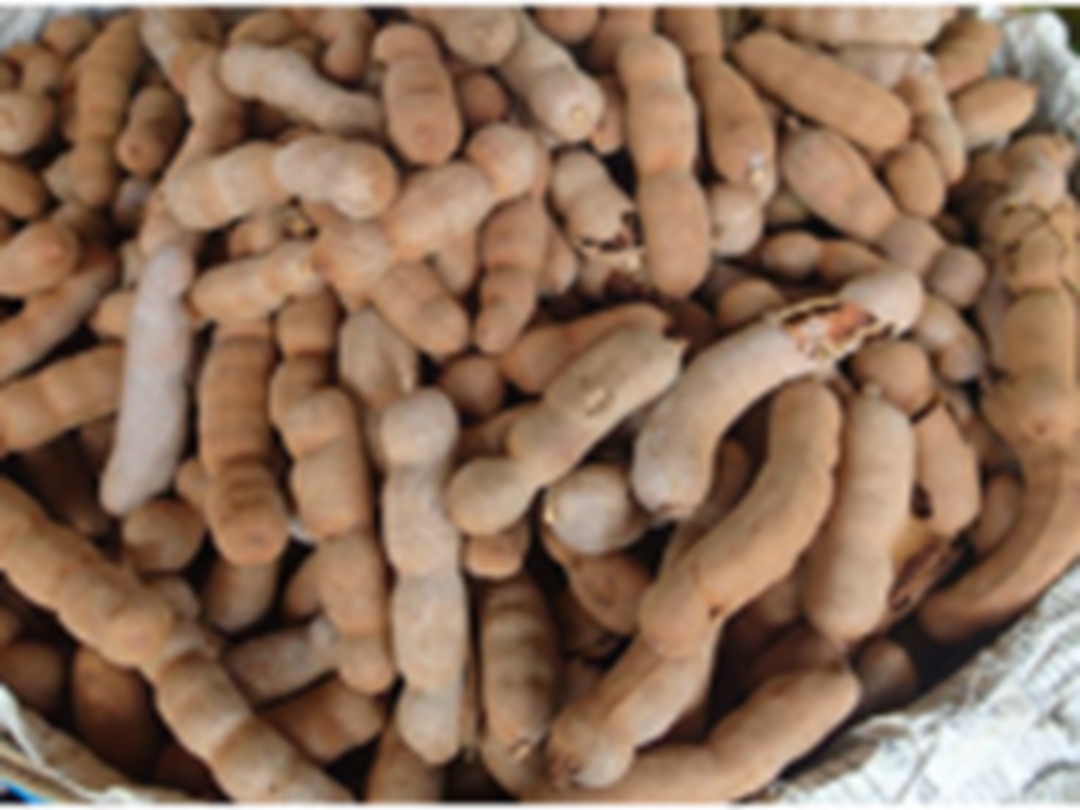
The fruit is an indehiscent capsule, oblong in shape, slightly flattened, 3–6 cm long, and slightly curved. The exocarp is brownish-red, slightly hard and brittle; the mesocarp is brownish-yellow or brownish-black, relatively thick, sour in taste, with several fibrous veins on the outer surface; the endocarp is leathery.The seeds are nearly round, 7–14 mm long and 6–11 mm wide, somewhat flattened, with a reddish-brown, smooth, glossy surface and faint fingerprint-like markings. When flattened, each side bears a nearly circular scar;the hilum is a small, slightly sunken dot, and the sympodium is also a small, slightly raised dot located opposite the hilum; the cotyledons are white, with a fragrant aroma and a sweet-sour taste. When pressed with sugar, the product forms a relatively firm lump; if carefully selected, intact specimens can be separated, resembling broad beans and containing 2–4 seeds. It has a distinctive odor, is strongly acidic, and the leaves are sweet.
Botanical Information
Botanical Classification
Tamarind (Tamarindus indica), a plant of the genus Tamarind in the Fabaceae family.
Morphological Characteristics
An evergreen large tree, reaching up to 20 meters in height. The bark is dark gray, rough, and longitudinally fissured. The leaves are even-pinnate and alternate; the petioles are short and stout; there are 7–20 pairs of leaflets, which are oblong or oblong-elliptic, 1–2.4 cm long and 4–9 mm wide, with rounded or slightly notched apices, nearly rounded and oblique bases, glabrous on both surfaces, and entire margins.Yellow flowers bloom in summer, arranged in terminal panicles or axillary racemes; the flowers are irregular. The calyx tube is slightly inverted triangular, with 4 sepals; the upper 3 petals are well-developed, yellow with purplish-red stripes, while the lower 2 are reduced to scale-like structures;There are 3 stamens; the filaments are fused below the middle, with 3–5 spiny, reduced stamens. The pod is thick and fleshy, dark brown, with a thin, brittle skin; the pulp is reddish-brown when ripe and has a sour taste, hence the name “sour角.” It contains 3–10 seeds, which are nearly rectangular and deep red with a glossy sheen.
Distribution Area
It is distributed in Fujian, Taiwan, Guangxi, Guangdong, Sichuan, Yunnan, and other provinces and regions.