Brown Bamboo is the name of a traditional Chinese medicinal material. It consists of the leaves of Rhapis excelsa (Thunb.) Henry ex Rehd., a plant in the Arecaceae family. It possesses astringent and hemostatic properties. It is primarily used to treat epistaxis, hemoptysis, hematemesis, and excessive postpartum bleeding.
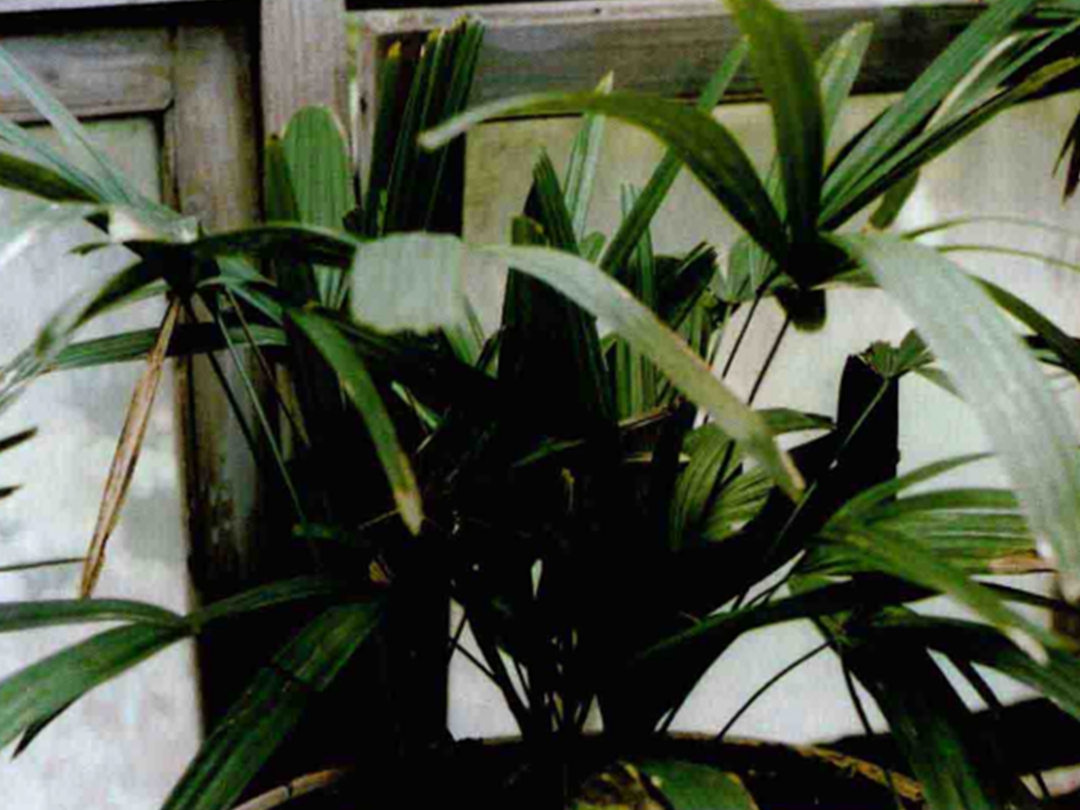
Palm Bamboo
Brown Bamboo is the name of a traditional Chinese medicinal material. It consists of the leaves of Rhapis excelsa (Thunb.) Henry ex Rehd., a plant in the Arecaceae family. It possesses astringent and hemostatic properties. It is primarily used to treat epistaxis, hemoptysis, hematemesis, and excessive postpartum bleeding.
Chinese Name : 棕竹
Nature, Flavor & Meridian Tropism : Taste: sweet and astringent; nature: neutral; enters the Liver and Kidney meridians
Benefits & Efficacy
Benefits
Astringent and hemostatic.
Indications
Epistaxis, hemoptysis, hematemesis, and excessive postpartum bleeding.
Usage and Dosage
Oral use: Calcined charcoal ground into powder and dissolved in water; 3–6 g.
Chemical Constituents
The leaves contain saponin (i.e., isomyrtine), methyl-protodioscin, methyl-protopalmate B, and methyl-protopalmate.
Relevant Discussions
*Fujian Materia Medica*: “Cools the blood and stops bleeding. Primarily used to treat hematemesis, epistaxis, and hemoptysis.”
Applications
Notes
Patients requiring treatment with Chinese herbal medicine should first consult a licensed Traditional Chinese Medicine (TCM) hospital, where a TCM practitioner will conduct a professional pattern differentiation and prescribe an herbal formula.
Processing & Preparation
Harvesting & Processing
Can be harvested year-round; cut into pieces and sun-dried.
Crude Drug Identification
Botanical Information
Botanical Classification
Palm family plant: Palm Bamboo.
Morphological Characteristics
A tufted shrub, 2–3 m tall. The stem is cylindrical, jointed, 2–3 cm in diameter, and covered in the upper part with brown, reticulate, coarse-fibrous leaf sheaths. Leaves are alternate; petioles are 8–20 cm long, initially covered with chaff-like hairs, slightly flattened, and elliptical in cross-section;Leaves are deeply palmately lobed, with 4–10 unequal lobes bearing 2–5 ribs; the lobes are joined at the base over a distance of 1–4 cm, 20–30 cm or longer in length, 1.5–5 cm wide, broadly linear or linear-elliptic, with a broad apex and irregularly notched margins; the margins and veins bear small, sharp brown teeth, and the transverse veins are numerous and prominent.Spadix up to 30 cm long, highly branched; spathe tubular, 2–3 in number, borne on the main peduncle and rachis, membranous, densely covered with brown, curled villi.The plant is dioecious; male flowers are smaller, with a 1.5 mm long calyx and ovate lobes; corolla lobes are ovate, thick, and 1 mm long; there are 6 stamens; female flowers are larger and ovoid-globose. The berry is globose, 8–10 mm in diameter. Seeds are globose, with the embryo located near the base, opposite the seed ridge. Flowering occurs from June to July.
Distribution Area
It is distributed from southeastern to southwestern China.
Growth Habits
It prefers a warm, humid climate and well-ventilated environments; it tolerates shade but is not cold-hardy. It is best cultivated in moist, well-drained, humus-rich acidic soil.
Propagation Methods
Propagate by seed or division.
Cultivation Techniques
1. Seedling Propagation and Transplanting: Sow seeds in spring after soaking and pre-germinating them; broadcast them evenly on a seedbed. Cover with 2–3 cm of fine soil and water thoroughly to maintain moisture. Cultivate for one year, then dig holes and transplant the seedlings at a spacing of 1 m × 0.5 m.
2. Division Propagation: In spring, dig up the mother plant, divide it into several clumps with roots attached, and transplant them as described above.