Stachys, a name in traditional Chinese medicine. Refers to the whole plant or roots of Stachys japonica Miq., Stachys chinensis Bunge ex Benth., or Stachys baicalensis Fisch. ex Benth., plants belonging to the genus Stachys in the Lamiaceae family. It has the effects of clearing heat and detoxifying, relieving coughs and soothing the throat, and stopping bleeding and reducing swelling.It is primarily used to treat the common cold, shā syndrome, pulmonary atrophy, lung abscess, headaches and dizziness, sore throat, loss of voice, hematemesis, hemoptysis, epistaxis, metrorrhagia and menorrhagia, dysentery, dysuria, and swelling and pain caused by trauma.
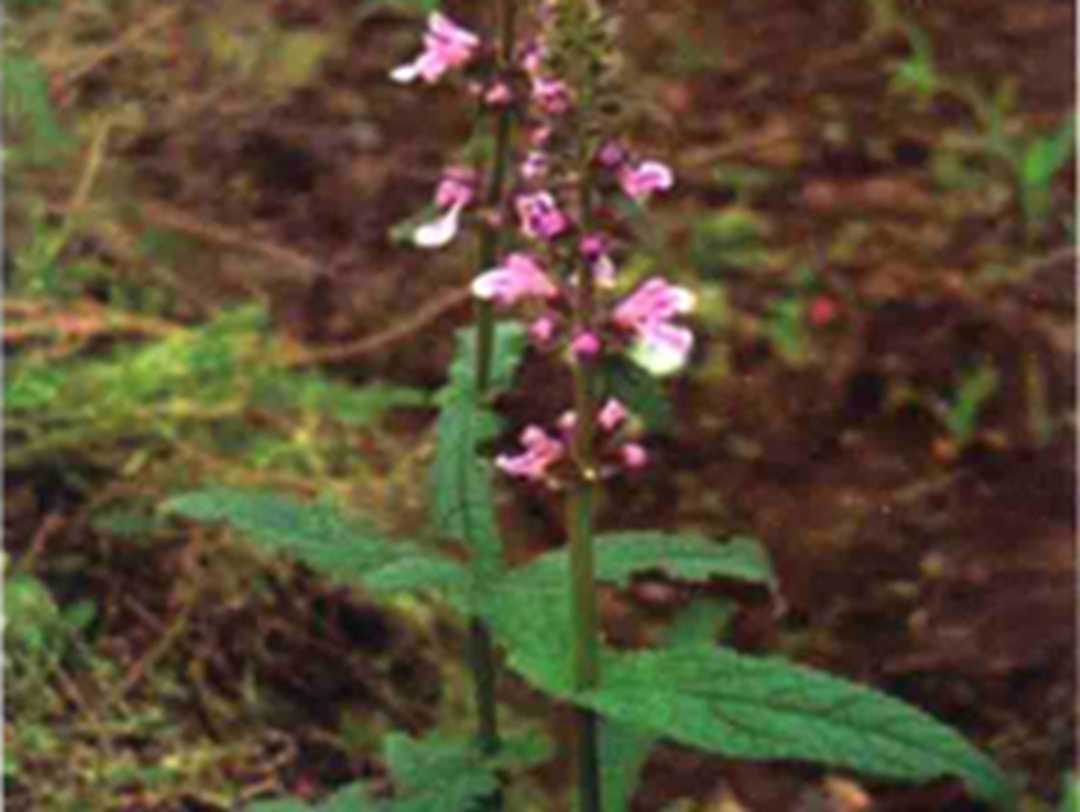
Stachys
Stachys, a name in traditional Chinese medicine. Refers to the whole plant or roots of Stachys japonica Miq., Stachys chinensis Bunge ex Benth., or Stachys baicalensis Fisch. ex Benth., plants belonging to the genus Stachys in the Lamiaceae family. It has the effects of clearing heat and detoxifying, relieving coughs and soothing the throat, and stopping bleeding and reducing swelling.It is primarily used to treat the common cold, shā syndrome, pulmonary atrophy, lung abscess, headaches and dizziness, sore throat, loss of voice, hematemesis, hemoptysis, epistaxis, metrorrhagia and menorrhagia, dysentery, dysuria, and swelling and pain caused by trauma.
Chinese Name : 水苏
Aliases : Chicken Perilla, Laozu, Mustard Seed, Borneol Mint, Fragrant Perilla, Mustard Root, Wild Perilla, Pengtou Grass, Mountain Cimicifuga, Black Thunder God, Chen Sha Grass, Water Chicken Perilla
Nature, Flavor & Meridian Tropism : Pungent in taste, cool in nature; enters the Lung and Stomach meridians
Benefits & Efficacy
Benefits
Clears heat and detoxifies; relieves cough and soothes the throat; stops bleeding and reduces swelling.
Indications
Common cold, shā syndrome, pulmonary atrophy, lung abscess, headache and dizziness, sore throat, loss of voice, hematemesis, hemoptysis, epistaxis, metrorrhagia and menorrhagia, dysentery, dysuria, and swelling and pain from trauma.
Usage and Dosage
1. Internal use: Decoct 9–15 g. 2. External use: Use an appropriate amount; decoct and use as a wash; or grind into a powder and sprinkle; or pound into a paste and apply as a poultice.
Precautions
Patients requiring treatment with Chinese herbal medicine should first consult a licensed Traditional Chinese Medicine (TCM) hospital to receive a prescription following a professional TCM differential diagnosis.
Relevant Discussions
1. *Shennong Bencao Jing*: “Eliminates bad breath, removes toxins, and dispels foul odors. Long-term use clarifies the mind, lightens the body, and delays aging.”
2. *Mingyi Bielu*: “Regulates qi, aids digestion, and promotes the absorption of food and drink. Treats hemoptysis, epistaxis, and menorrhagia.”
3. *Dietary Therapy Materia Medica*: “Raw leaves, pounded while hot and wrapped in cotton, can be inserted into the ears to treat deafness. For those suffering from headaches and dizziness, drink one sheng of decoction made by boiling the herb in clear wine. It is particularly effective for postpartum stroke. The ash from the herb or its decoction can be used to wash the hair, making it fragrant and preventing dandruff.”
4. *Rihua Zi*: “Treats pulmonary atrophy, metrorrhagia, leukorrhea, and bloody dysentery.”
5. *Illustrated Compendium of Materia Medica*: “Treats various qi-related disorders and leg swelling.”
6. *New Compilation of Herbal Medicine*: “Treats loss of voice due to lung deficiency, hemoptysis, and associated damage.”
Applications
Clinical Applications
1. For wind-heat headaches, heat accumulation in the upper burner causing wind, and phlegm-induced syncope headaches: 5 liang of water hyssop leaves, 3 liang of soapberry (roasted, with skin and seeds removed), and 1 liang of Chinese winterflower (stir-fried with vinegar until charred). Grind into a powder and mix with refined honey to form pills the size of goji berries. Take twenty pills each time after meals, washed down with Schizonepeta Decoction. (*Shenghui Fang*)
2. For treating herpes zoster: Pound the rhizome of (Perilla frutescens) to extract the juice, then apply it to the affected area. (New Compilation of the Materia Medica of Southern Zhejiang)
3. For treating tonsillitis and pharyngitis: ① 30g of Perilla frutescens; decoct in water and drink, or pound to extract the juice and drink; or combine 30g of this herb with 30g of fresh Achyranthes root and 9g of Achyranthes root. Decoct in water and drink.(*New Compilation of Materia Medica of Southern Zhejiang*) ② 30 g each of water hyssop, Isatis root, white茅根, and wild Achyranthes root. Decoct and drink. (*Flora of Medicinal Plants of Zhejiang*)
4. For cough and loss of voice: 30 g of water hyssop and 15 g of creeping violets. Decoct, mix with rock sugar, and drink.
5. For whooping cough: 30 g of the whole water hyssop plant,decoct in water and drink (reduce to half the dose for infants); or combine with 30g of Allium tuberosum, 15g each of Angelica sinensis, and Solidago virga-auri. (Decoct in water and drink.) (Formulas 4–5 are from *New Compilation of Materia Medica of Southern Zhejiang*)
6. For hemoptysis, hematochezia, and metrorrhagia: Extract the juice from the stems and leaves of Water Hyssop and drink it. (*Collected Effective Formulas of Master Mei*)
7. For hemoptysis: 30 g of fresh whole Shuisu herb, 9 g of Tu Da Huang, 15 g of Liu Yue Shuang, and 9 g of Juan Bai. Decoct in water, then mix with pork broth before taking. (Jiangxi *Manual of Herbal Medicine*)
8. For epistaxis: ① 5 he of raw Shuisu, 2 he of Xiang Chi. Pound together with a mortar and pestle, roll into balls the size of a jujube pit, and insert into the nostrils.(*Master Mei’s Collection of Proven Formulas*) ② 15–30g of water hyssop; decoct in water and drink. (*Enshi Handbook of Chinese Herbal Medicine*)
9. For persistent hematuria: One handful of chicken hyssop, one handful of bamboo leaves (sliced), 0.8 fen of gypsum (crushed), 1 sheng of raw rehmannia root (sliced), and 0.4 fen of hollyhock seeds (powdered; add to the decoction just before completion). Boil 6 sheng of water down to 2 sheng.Strain out the residue, mix in the mallow seed powder, and divide into two warm doses. Take one dose after walking four or five li. (From *Guangji Fang*: Jisu Decoction)
10. For treatment of contusions and bruises: 30 g of fresh Shuisu stems and leaves; pound and squeeze to extract the juice; boil with sweet wine until it comes to a boil, then drink while hot. (From *Jiangxi Herbal Medicine Manual*)
Notes
References: [1] Nanjing University of Chinese Medicine. *Encyclopedia of Chinese Materia Medica* [M]. 2nd ed. Shanghai: Shanghai Science and Technology Press, 2006. [2] Editorial Committee of *Zhonghua Bencao*, State Administration of Traditional Chinese Medicine. *Zhonghua Bencao*: Vol. 7 [M]. Shanghai: Shanghai Science and Technology Press, 1999.
Processing & Preparation
Harvesting & Processing
Harvested in July–August; used fresh or sun-dried.
Crude Drug Identification
Properties of Crude Drugs
The stem is quadrangular, 15–40 cm long, and 0.1–0.3 cm in diameter; the surface is yellowish-green to greenish-brown; it is relatively rough, with sparse, downward-pointing, soft-haired bristles on the ridges and nodes.Leaves are opposite; petioles are 1–5 mm long; when spread flat, leaves are oblong-lanceolate, 1.5–8 cm long and 0.6–1.5 cm wide, with distinctly serrated margins.Flowers are usually arranged in whorls of six, borne in the upper leaf axils of the stems and branches; the calyx is bell-shaped with five teeth, the tips of which are sharply pointed, and the surface bears glandular hairs. The nutlets are ovoid-triangular, black, and relatively smooth. Slight odor, bland taste.
Botanical Information
Botanical Classification
Species of the genus Perilla in the Lamiaceae family, such as Perilla frutescens, Perilla chinensis, or Perilla villosa.
Morphological Characteristics
1. Perilla: A perennial herb with creeping rhizomes. The stem is 20–80 cm tall and bears small bristles at the nodes.Leaves are opposite; petioles are 3–17 mm long, longest near the base of the stem and gradually shorter toward the apex; leaf blades are oblong-lanceolate, 5–10 cm long and 1–2.3 cm wide, with a slightly acute apex, a rounded to slightly cordate base, and rounded-toothed margins; both surfaces are glabrous.Inflorescences are verticillate, bearing 6–8 flowers; the lower ones are widely spaced, while the upper ones are arranged in a slightly denser cluster to form a pseudospike 5–13 cm long; bracteoles are spiny and minute; the calyx is campanulate, up to 7.5 mm long including the teeth, externally covered with glandular pubescence, rarely with appressed hairs or nearly glabrous, 10-veined, with 5 teeth that are triangular-lanceolate and have spiny tips;Corolla pink or pale reddish-purple, about 1.2 cm long, with a ring of hairs inside the tube; corolla lip bilabiate, upper lip erect, lower lip 3-lobed, with the middle lobe nearly circular; stamens 4, all extending below the upper lip; style filiform, apically equally 2-lobed; ovary glabrous. Nutlets ovoid, glabrous. Flowering period: July–September.
2. Chinese Water Hyssop: A perennial, erect herb. The stem is about 60 cm tall, simple and unbranched, or branched at the base; it is quadrangular, with sparse, downward-pointing, soft, bristly hairs on the ridges and nodes, and glabrous elsewhere. Leaves are opposite; petioles are extremely short, 2–5 mm long, or nearly sessile;leaf blades oblong-lanceolate, 5.5–8.5 cm long, 1–1.5 cm wide, with a blunt apex and a nearly rounded base, almost glabrous on both surfaces. The whorled cymes usually consist of 6 flowers, arranged sparingly to form a long pseudospike; bracts are lanceolate with bristly margins, and the bracteoles are minute;The calyx is campanulate, approximately 1 cm long including the teeth; the outer surface is covered with soft bristles along the ribs and margins of the teeth; it has 10 veins and 5 lanceolate teeth; the corolla is purple, 1.5 cm long, with an indistinct ring of hairs inside the corolla tube; the corolla is bilabiate, with the upper lip erect and the lower lip 3-lobed, the middle lobe nearly circular.The nutlets are ovoid-trigonal and glabrous. Flowering period: June–August.
3. Hairy Water-hyssop: A perennial, erect herb. The stem is 50–100 cm tall, simple or branched toward the top, slenderly angular, and densely covered with backward-pointing to spreading bristles along the ridges and nodes.Leaves are opposite; petioles are 1–2 mm long or nearly sessile; leaf blades are oblong-linear, 4–11 cm long and 0.7–1.5 cm wide, sparsely bristly on both surfaces. The verticillate inflorescences usually consist of 6 flowers, with most arranged in pseudospikes on the upper part of the stem; bracteoles are linear, acuminate, and bristly;the calyx is campanulate, 9 mm long including the teeth, densely covered on the outside along the ribs and at the margins of the teeth with soft, nodular bristles; it has 10 veins; the teeth are 5, lanceolate-triangular, with a spiny tip; the corolla is pale purple to purple, up to 1.5 cm long, with a ring of hairs inside the corolla tube; the corolla is bilabiate, with the upper lip erect and the lower lip 3-lobed, the middle lobe nearly circular.The nutlets are ovoid. Flowering occurs in summer.
Distribution Area
1. Water-hyssop: Distributed in Liaoning, Inner Mongolia, Hebei, Shandong, Jiangsu, Anhui, Zhejiang, Jiangxi, Fujian, and other areas. 2. Chinese water-hyssop: Distributed in Northeast China, as well as Inner Mongolia, Hebei, Shanxi, Shaanxi, and Gansu. 3. Hairy water-hyssop: Distributed in Heilongjiang, Jilin, Liaoning, Inner Mongolia, Hebei, Shanxi, Shaanxi, Shandong, and other areas.