Soft-shelled turtle eggs are a traditional Chinese medicinal material. They are the eggs of the Chinese soft-shelled turtle (Trionyx sinensis (Wiegmann)) or the mountain soft-shelled turtle (T. steindachneri Siebenrock) of the Trionychidae family. They have the effects of nourishing yin and stopping dysentery. They are primarily used to treat chronic diarrhea and dysentery in children.
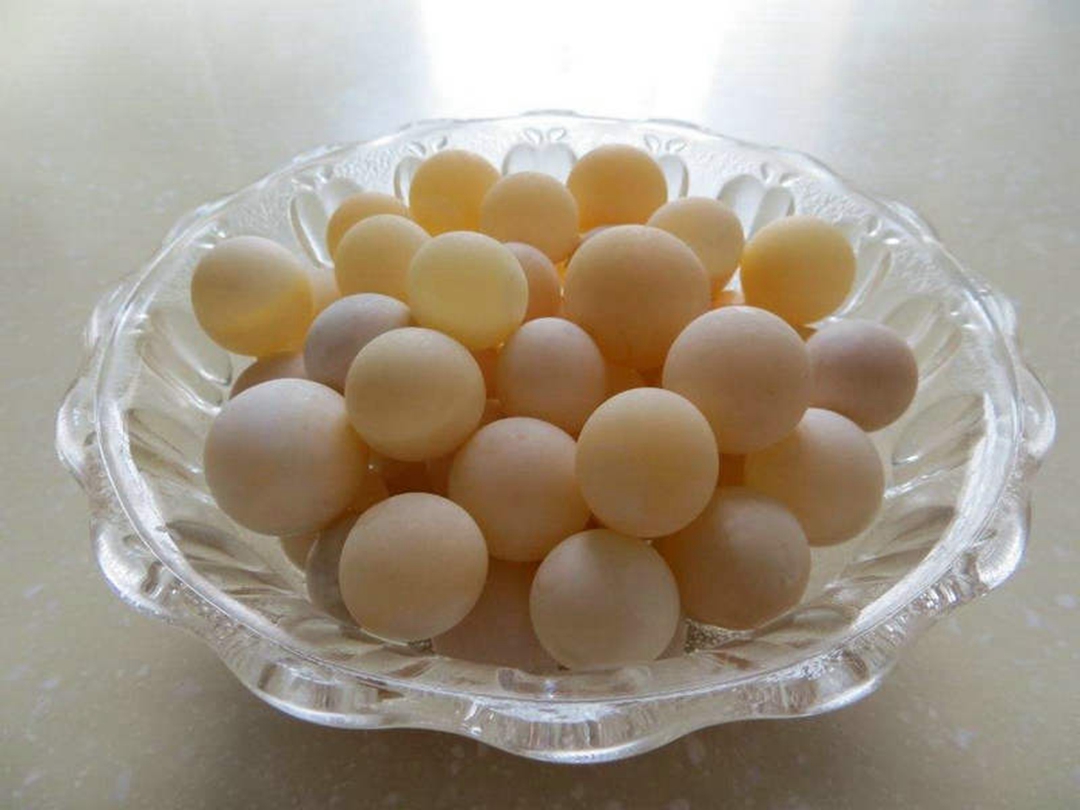
Soft-shelled Turtle Eggs
Soft-shelled turtle eggs are a traditional Chinese medicinal material. They are the eggs of the Chinese soft-shelled turtle (Trionyx sinensis (Wiegmann)) or the mountain soft-shelled turtle (T. steindachneri Siebenrock) of the Trionychidae family. They have the effects of nourishing yin and stopping dysentery. They are primarily used to treat chronic diarrhea and dysentery in children.
Chinese Name : 鳖卵
Nature, Flavor & Meridian Tropism : Salty in taste, cold in nature
Benefits & Efficacy
Benefits
Nourishes yin and stops dysentery.
Indications
Chronic diarrhea and dysentery in children.
Usage and Dosage
Oral use: Boil and eat 2–6 pieces.
Relevant Discussions
1. *Ben Cao Meng Quan*: “Boil after soaking in salt water and consume; also effective for replenishing yin deficiency.”
2. *Compendium of Materia Medica*: “Bake after salt-curing and consume; stops diarrhea in children.”
3. *Essentials of Medical Literature: Medicinal Properties*: “Treats chronic diarrhea and dysentery.”
Applications
Related Compatibility
For treating chronic diarrhea and dysentery in children: Soak soft-shelled turtle eggs in salt water, then boil until cooked. Consume 2 eggs three times daily, or cook them into congee. (*Medicinal Animals of Guangxi*)
Processing & Preparation
Harvesting & Processing
Collect during the egg-laying season (May–August) along the banks of rivers, lakes, and ponds; use fresh or refrigerated.
Crude Drug Identification
Botanical Information
Morphological Characteristics
1. Chinese Soft-shelled Turtle: The body is oval or nearly oval-round in shape, with an adult total length of approximately 30–40 cm.The head is pointed, with a long snout forming a short, tubular rostrum; the nostrils are located at the tip of the rostrum. The edges of the upper and lower jaws are covered with a hard keratinous sheath and are toothless; the eyes are small; the pupils are round; the eardrum is not prominent; the neck can reach a length of over 70 mm; the base of the neck lacks granular warts; and the head and neck can be completely retracted into the shell.Both the carapace and plastron lack keratinous plates and are covered with leathery, soft skin; the margins are lined with soft, relatively thick connective tissue, commonly known as the “skirt.” The dorsal skin features small protruding warts arranged in longitudinal ridges; the central dorsal region is slightly convex. There are 8 pairs of vertebral plates and 8 pairs of costal plates; there are no ischial plates, and the margins are not connected by marginal plates.The dorsal scutes are not fully ossified; the ribs are fused to the costal scutes, with their tips protruding beyond the lateral edges of the costal scutes. The limbs are relatively flat; the forelimbs have five digits. The inner three digits have exposed claws, while the claws of the outer two digits are completely enclosed by skin and not exposed. The claws on the hind limbs follow the same pattern, and the webbing between the fingers and toes is well-developed.Males have a flatter body and a longer tail, the tip of which extends beyond the skirt; females have a thick, short tail that does not extend beyond the skirt. The cloacal opening is longitudinally slit. The upper surface of the head and neck is olive green, while the underside is yellow; there are yellow markings from the lower jaw to the throat; black stripes run in front of and behind both eyes; and there are more than 10 black spots on the top of the head behind the eyes.The dorsal side of the body is olive green or dark brown with black spots; the ventral side is flesh-yellow, with large green markings on the flanks near the skirt edges and two pea-sized green spots near the tail. The upper surface of the forelimbs is olive green; the underside is pale yellow, while the upper surface of the hindlimbs is lighter in color. The central portion of the tail is olive green, with the remainder pale yellow.2. Mountain Softshell Turtle: The body is nearly circular; when weighing 9 kg, it measures 36 cm × 21 cm in length and width, respectively, and larger individuals can reach 20 kg. The carapace is domed, with rough skin; the carapace, margins, base of the neck, limbs, and tail all feature fleshy, spike-like protrusions of varying sizes; these spikes are larger and more densely clustered on the posterior part of the carapace. The fleshy flaps along the margins are very thick.The limbs are stout and laterally compressed. The tail is short, slightly flattened and conical, with a broad base and a pointed tip. The body is grayish-black, dark green, purplish-black, or dark blue-green. The head and limbs are jet-black or dark green. The ventral surface is jet-black with a purplish tint and features dark patches.
Distribution Area
1. Chinese Softshell Turtle: Except for Xinjiang, Ningxia, Qinghai, and Tibet—where no records have been reported—it is widely distributed throughout the country. 2. Mountain Softshell Turtle: Found in Guangdong, Hainan, Guangxi, Guizhou, and Yunnan.