Lasia spinosa, a name in traditional Chinese medicine. It refers to the rhizome or the whole plant of Lasia spinosa (L.) Thwai, a member of the Araceae family. It is distributed in Taiwan, Guangdong, Hainan, Guangxi, Yunnan, and other regions. It has the effects of clearing heat and draining dampness, detoxifying and reducing swelling, and strengthening the stomach and aiding digestion.It is commonly used to treat thirst associated with febrile illnesses, coughs caused by lung heat, yellowish-red urine, edema due to nephritis, leukorrhea, rheumatic pain, swelling and pain from trauma, chronic gastritis, indigestion, scalp sores in children, fetal toxicity, mumps, lymph node tuberculosis, boils, abscesses, and sores, as well as venomous snake bites.
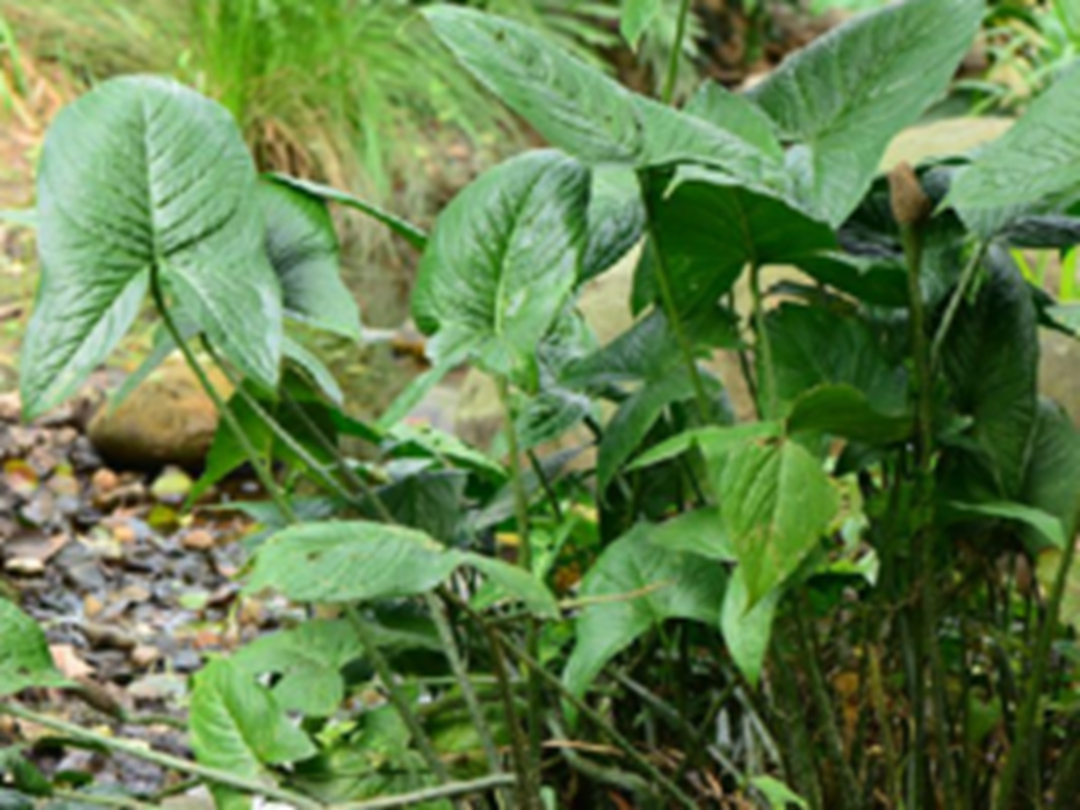
Lasia spinosa
Lasia spinosa, a name in traditional Chinese medicine. It refers to the rhizome or the whole plant of Lasia spinosa (L.) Thwai, a member of the Araceae family. It is distributed in Taiwan, Guangdong, Hainan, Guangxi, Yunnan, and other regions. It has the effects of clearing heat and draining dampness, detoxifying and reducing swelling, and strengthening the stomach and aiding digestion.It is commonly used to treat thirst associated with febrile illnesses, coughs caused by lung heat, yellowish-red urine, edema due to nephritis, leukorrhea, rheumatic pain, swelling and pain from trauma, chronic gastritis, indigestion, scalp sores in children, fetal toxicity, mumps, lymph node tuberculosis, boils, abscesses, and sores, as well as venomous snake bites.
Chinese Name : 竻慈姑
Latin Name : Lasia spinosa (L.) Thwai.
Aliases : Tianhe Taro, Lezhuru, Water Zhenhou, Lemeng, Zhen Taro, Zhen Lotus Root, Le Ciru, Le Taro, Qiaonan, Wild Ciru, Mountain Ciru, Water Le Taro, Youle Ciru, Dry Ciru
Authentic Producing Area : Taiwan, Guangdong, Hainan, Guangxi, Yunnan
Nature, Flavor & Meridian Tropism : Bitter and pungent in taste; cool in nature; enters the Heart, Lung, and Bladder meridians
Benefits & Efficacy
Benefits
Clears heat and drains dampness; detoxifies and reduces swelling; strengthens the stomach and aids digestion.
Indications
Used for thirst due to fever, cough caused by lung heat, yellowish-red urine, edema caused by nephritis, leukorrhea, rheumatic pain, swelling and pain from trauma, chronic gastritis, indigestion, scalp sores in children, fetal toxicity, mumps, lymph node tuberculosis, boils, abscesses, and snake bites.
Usage and Dosage
Internal use: Decoct 9–15 g. External use: Apply an appropriate amount; decoct in water for washing, or grind into a powder and apply as a poultice.
Precautions
Not yet established.
Pharmacological Actions
Anti-inflammatory, expectorant, and cough-suppressing effects.
Relevant Discussions
*Compendium of Chinese Herbal Medicines*: “Anti-inflammatory, analgesic, aids digestion, and strengthens the stomach. Primarily used to treat chronic gastritis, indigestion, rheumatoid arthritis; externally applied to treat venomous snake bites, lymphadenitis, and lymph node tuberculosis.”
Applications
Related Compatibility
1. For leukorrhea, dysmenorrhea, nephritis, and cloudy urine: 9–15 g of the whole *Spiny Taro* plant. Decoct in water or simmer with pork bones and consume. (*Selected Compendium of Guangxi Materia Medica*)
2. For rheumatic arthralgia and trauma: 9–15 g of the whole *Spiny Taro* plant, decocted and taken orally;or use 60 g of the whole plant of (Prickly Taro), steeped in 500 g of wine. Take internally and apply externally. (*Selected Compendium of Guangxi Materia Medica*)
3. For treating abscesses, swellings, boils, and mumps: Pound fresh rhizomes of (Prickly Taro) into a paste and apply externally. (*Selected Compendium of Guangxi Materia Medica*)
Processing & Preparation
Harvesting & Processing
Harvest in summer or fall; dig up the rhizome or the whole plant, wash thoroughly, and sun-dry or chop into pieces before sun-drying.
Crude Drug Identification
Properties of Crude Drugs
The dried rhizome is cylindrical, with a brownish-red surface featuring raised nodules and sharp, hard spines; internodes are approximately 6–7 cm long. It bears residual lateral root scars and the bases of leaf petioles that curl inward. The herbal material is often cut into oblique slices; the cross-section is grayish-white or pinkish, powdery, and dotted with numerous small brown spots. It has a numbing and spicy taste.
Botanical Information
Botanical Classification
A plant of the Araceae family, known as Spiny Taro.
Morphological Characteristics
A perennial, spiny, evergreen herb that can grow up to 1 meter tall. The stems are grayish-white, cylindrical, up to 4 centimeters in diameter, creeping, and more or less covered with spines; internodes are 2–5 centimeters long and bear cylindrical, fleshy roots; fibrous, finely branched fibrous roots; nodes are annular and more or less swollen.Petiole longer than the leaf blade, 20–50 cm long; leaf blades vary in shape: on young plants, they are lanceolate, 6–10 cm long and 9–10 cm wide, transitioning in mature plants to deeply pinnately lobed with bird’s-foot-like lobes, 20–60 cm in length and width; upper surface green, lower surface pale green with sparse spines along the veins; base with a short, wide emargination, rarely truncate;lateral lobes number 2–3, linear-oblong or oblong-lanceolate, more or less acuminate, gradually narrowing toward the base; the lowest lobe is further ternately lobed, with the smallest lobes 15–20 cm long and 2–3 cm wide.The inflorescence stalk is 20–35 cm long and 0.75–1 cm thick; the spathe is 15–30 cm long, with a tube 3–5 cm long and a lamina 25 cm long, spirally twisted toward the upper part. The spadix is cylindrical, blunt, 2–3 (–4) cm long, 0.75 cm thick, and yellowish-green.The fruit cluster is 6–8 cm long and 3–3.5 cm in diameter. The berries are obovate with a quadrangular apex, 1 cm long, and the apex is usually densely covered with small wart-like projections. Seeds are 5 mm long and 3.5 mm in diameter. Flowering occurs in September, and the fruit ripens in February of the following year.
Distribution Area
Distributed in Taiwan, Guangdong, Hainan, Guangxi, Yunnan, and other areas.