“Rat’s Footprints,” a name in traditional Chinese medicine. It refers to the whole plant of Epaltes australis Less. (Asteraceae). It is distributed in Fujian, Taiwan, Guangdong, Hainan, Guangxi, and Yunnan, among other places. It has the efficacy of removing blood stasis and relieving pain. It is commonly used for contusions and bruises, as well as redness, swelling, and pain in the eyes.
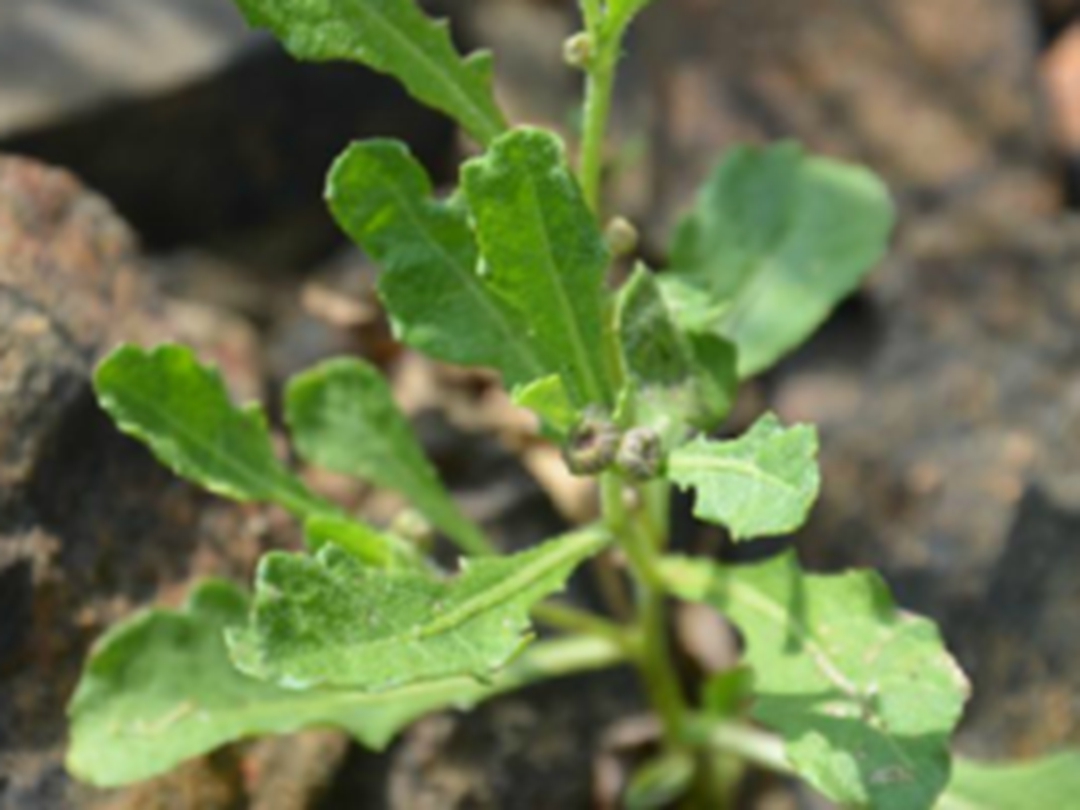
Mouse Footprint
"Rat’s Footprints," a name in traditional Chinese medicine. It refers to the whole plant of Epaltes australis Less. (Asteraceae). It is distributed in Fujian, Taiwan, Guangdong, Hainan, Guangxi, and Yunnan, among other places. It has the efficacy of removing blood stasis and relieving pain. It is commonly used for contusions and bruises, as well as redness, swelling, and pain in the eyes.
Chinese Name : 老鼠脚迹
Aliases : Ground Pepper, Big Goose-Repelling Herb, Goose-Repelling Herb
Authentic Producing Area : Fujian, Taiwan, Guangdong, Hainan, Guangxi, and Yunnan
Nature, Flavor & Meridian Tropism : Pungent in taste, warm in nature; enters the Liver and Stomach meridians
Benefits & Efficacy
Benefits
Removes blood stasis and relieves pain.
Indications
Traumatic injuries; redness, swelling, and pain in the eyes.
Usage and Dosage
External use: Apply an appropriate amount, pounded and applied as a poultice.
Precautions
Use with caution during pregnancy.
Relevant Discussions
1. *Lu Chuan Bencao*: “Removes blood stasis and relieves pain. Treats swelling and pain from falls and blows, as well as epidemic red eye.”
2. *Catalog of Medicinal Plants of Guangxi*: “Stops bleeding and regulates qi. Treats internal injuries; its efficacy is comparable to that of *Shi Hu Wei*.”
Applications
Related Compatibility
For swollen and painful red eye: 9 g each of Mouse Footprint, Field-Base Yellow, and Plowshare Grass. Pound into a paste and apply to the Hegu acupoint. Apply to the left side for pain in the right eye, and to the right side for pain in the left eye. (*Lu Chuan Bencao*)
Notes
Peng Ze-nan: Goose-Not-Eat-Grass is a key herb used by farmers to treat sprains and tendon injuries; crushing it and applying it as a paste mixed with alcohol yields good results.
Processing & Preparation
Harvesting & Processing
Harvest in summer and fall; wash thoroughly and use fresh.
Crude Drug Identification
Botanical Information
Botanical Classification
Asteraceae family, genus *Globularia*, species *Globularia*.
Morphological Characteristics
Globe Chrysanthemum, also known as Yi Ba Chrysanthemum or Fist Chrysanthemum. An annual herb. Stems and branches are spreading or prostrate, 6–20 cm long, 2–3 mm in diameter, densely branched at the base, finely grooved, glabrous or sparsely covered with coarse hairs, with internodes approximately 1 cm long.Leaves are sessile or have short petioles up to 5–7 mm long; leaf blades are obovate or obovate-oblong, 1.5–3 cm long, 5–11 mm wide, gradually narrowing toward the base, with a blunt apex (rarely short-pointed), irregularly coarsely serrated margins, glabrous or sparsely pubescent; the midvein is prominent on the upper surface and slightly raised on the lower surface; lateral veins number 2–3 pairs,extremely fine and weak; reticulate veins are not prominent. The inflorescences are numerous, flattened-globose, about 5 mm in diameter, with no peduncle or a short one, lateral, solitary or in pairs; the involucre is hemispherical, 5–6 mm in diameter, about 3 mm long;the involucral bracts in 4 layers, green, dry and membranous, glabrous; the outer layer ovate, 1.5 mm long, with a rounded apex; the inner layer obovate to obovate-oblong, about 2 mm long, with a blunt or slightly pointed apex; the receptacle slightly convex, glabrous. Female flowers numerous, about 1 mm long, with the corolla lobes 3-toothed and sparsely glandular-dotted.There are about 20 bisexual flowers, each approximately 2 mm long; the corolla is cylindrical, with the lobe 4-lobed, the lobes triangular, the apex slightly obtuse, and bearing glandular dots; there are 4 stamens. The achene is nearly cylindrical, with 10 ridges, approximately 1 mm long, bearing wart-like projections, with a truncate apex, the base often constricted, and covered with sparse, short soft hairs.No pappus. Flowering period: March–June and September–November.
Distribution Area
Distributed in Fujian, Taiwan, Guangdong, Hainan, Guangxi, and Yunnan, among other places.