Podocarpus root bark is a name for a traditional Chinese medicine. It is the root bark of Podocarpus macrophyllus (Thunb.) D. Don or Podocarpus macrophyllus (Thunb.) D. Don var. maki Endl., plants of the Podocarpaceae family. Podocarpus is distributed in southwestern China as well as in Jiangsu, Anhui, Zhejiang, Jiangxi, Fujian, Hunan, Guangdong, and Guangxi.Short-leaved Podocarpus is cultivated in southwestern China as well as in Shaanxi, Jiangsu, Zhejiang, Jiangxi, Fujian, Hubei, Hunan, Guangdong, and Guangxi, where it is used as an ornamental garden tree; it is also grown in pots in Beijing. It has the therapeutic effects of promoting blood circulation and removing blood stasis, dispelling wind and dampness, and killing parasites and relieving itching. It is commonly used to treat contusions and sprains, rheumatic pain, and tinea infections.
Podocarpus Root Bark
Podocarpus root bark is a name for a traditional Chinese medicine. It is the root bark of Podocarpus macrophyllus (Thunb.) D. Don or Podocarpus macrophyllus (Thunb.) D. Don var. maki Endl., plants of the Podocarpaceae family. Podocarpus is distributed in southwestern China as well as in Jiangsu, Anhui, Zhejiang, Jiangxi, Fujian, Hunan, Guangdong, and Guangxi.Short-leaved Podocarpus is cultivated in southwestern China as well as in Shaanxi, Jiangsu, Zhejiang, Jiangxi, Fujian, Hubei, Hunan, Guangdong, and Guangxi, where it is used as an ornamental garden tree; it is also grown in pots in Beijing. It has the therapeutic effects of promoting blood circulation and removing blood stasis, dispelling wind and dampness, and killing parasites and relieving itching. It is commonly used to treat contusions and sprains, rheumatic pain, and tinea infections.
Chinese Name : 罗汉松根皮
Nature, Flavor & Meridian Tropism : It has a sweet and slightly bitter taste and a slightly warm nature. It enters the Lung, Stomach, and Liver meridians.
Benefits & Efficacy
Benefits
Promotes blood circulation and removes blood stasis; dispels wind and dampness; kills parasites and relieves itching.
Indications
Traumatic injuries, rheumatic arthralgia, and tinea infections.
Usage and Dosage
Internal use: Decoct 9–15 g. External use: Apply an appropriate amount, pounded into a paste; or decoct in water for fumigation or washing.
Relevant Discussions
*Fujian Materia Medica*: “The root bark of the Bodhi pine promotes blood circulation and removes blood stasis, kills parasites, and relieves itching. It is primarily used to treat traumatic injuries and tinea.” “The small Bodhi pine (root, bark, and leaves) promotes blood circulation and unblocks the meridians, dispels wind, and removes dampness. It is primarily used to treat rheumatic joint pain and traumatic injuries.”
Applications
Clinical Applications
Treatment of Fractures.
Related Compatibility
1. For contusions and bruises: Equal parts fresh root bark of Dwarf Podocarpus and Sophora flavescens root. Pound with rice wine into a paste and apply to the affected area; change the dressing once daily. (*Flora of Medicinal Plants of Tianmu Mountain*)
2. For ringworm: Equal parts fresh Podocarpus root bark (soaked in vinegar for half a day) and fresh sheep’s foot, plus an appropriate amount of brown sugar. Pound the mixture into a paste and apply to the affected area twice daily. (From *Anhui Chinese Herbal Medicine*)
Processing & Preparation
Harvesting & Processing
Harvest throughout the year or in the fall; wash thoroughly; use fresh or sun-dry.
Crude Drug Identification
Botanical Information
Botanical Classification
Plants of the genus Podocarpus, such as Podocarpus macrophyllus or Podocarpus brevifolius.
Morphological Characteristics
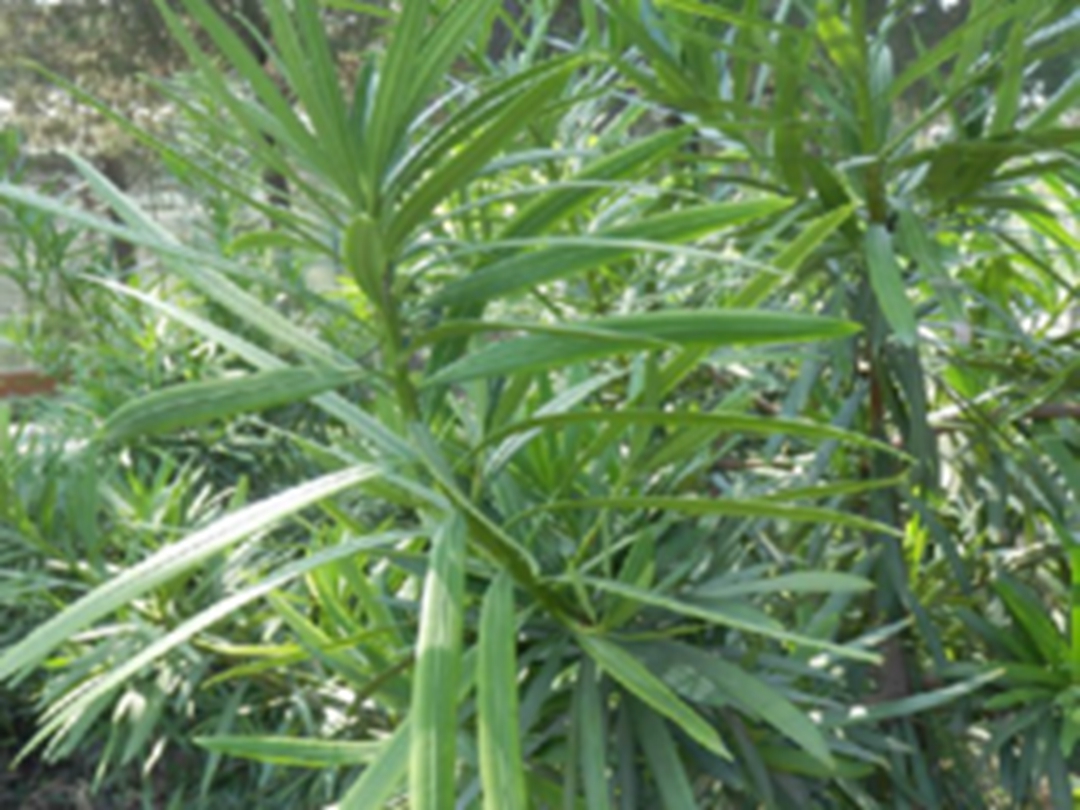
1. Podocarpus: Also known as Changqing, Luohan Cedar, or Native Cedar. An evergreen tree reaching up to 20 m in height. The bark is gray or grayish-brown, with shallow vertical fissures, and peels off in thin flakes; branches are spreading or obliquely spreading, with dense foliage.Leaves are spirally arranged, linear-lanceolate, slightly curved, 7–12 cm long, 7–10 mm wide, with an acuminate or obtuse apex, a cuneate base, and a short petiole; the upper surface is dark green and glossy, with a prominently raised midrib, while the lower surface is whitish or pale green, with a slightly raised midrib.The plant is dioecious; male cones are spike-like, usually clustered in groups of 3–5 (rarely 7) on very short peduncles, 3–5 cm long; female cones are solitary in leaf axils and stalked.Seeds are ovoid-globose, 1–1.2 cm in diameter; when ripe, the fleshy aril is purple or purplish-red, covered with a white powdery coating, and attached to a thick, fleshy seed receptacle that is red or purplish-red; the pedicel is 1–1.5 cm long. Flowering occurs from April to May, and seeds ripen from August to September.2. Short-leaved Podocarpus: Also known as “Short Green,” “Dwarf Podocarpus,” “Small-leaved Podocarpus,” or “Short-leaved Native Cypress.” This species differs from the common Podocarpus in that it is a small tree or shrub with branches that spread upward and outward. The leaves are short and densely arranged, 2.5–7 cm long and 3–7 mm wide, with blunt or rounded tips.
Distribution Area
Podocarpus: Distributed in southwestern China and in Jiangsu, Anhui, Zhejiang, Jiangxi, Fujian, Hunan, Guangdong, and Guangxi.